We use cookies to enhance your browsing experience and analyze site traffic. By continuing to use this site, you agree to our cookie policy. Privacy Policy
Clickmab at CBA-China 2026: AI-Driven Antibody R&D Practice and Exploration
Clickmab showcased its multi-agent AI antibody design platform Click.mAb. at CBA-China 2026, sharing the latest practices in de novo design, affinity maturation, humanization, and R&D collaboration.
In the past, AI was largely seen as a supporting tool. Today, it has begun to enter the R&D process itself—contributing to target analysis, antibody design, structure prediction, and humanization, and even reshaping how teams collaborate and make decisions.
At the ongoing CBA-China 2026 annual conference in China, this transformation has become a central discussion topic.
As an innovation company focused on AI antibody design, Clickmab brought its self-developed multi-agent AI antibody design platform—Click.mAb.—to the conference, engaging in deep conversations with industry partners about a new AI-driven antibody R&D paradigm and sharing our latest practical achievements in AI de novo antibody design, affinity maturation, humanization, and R&D collaboration.
AI Is Not Just an Accelerator—It Is Changing the R&D Pathway
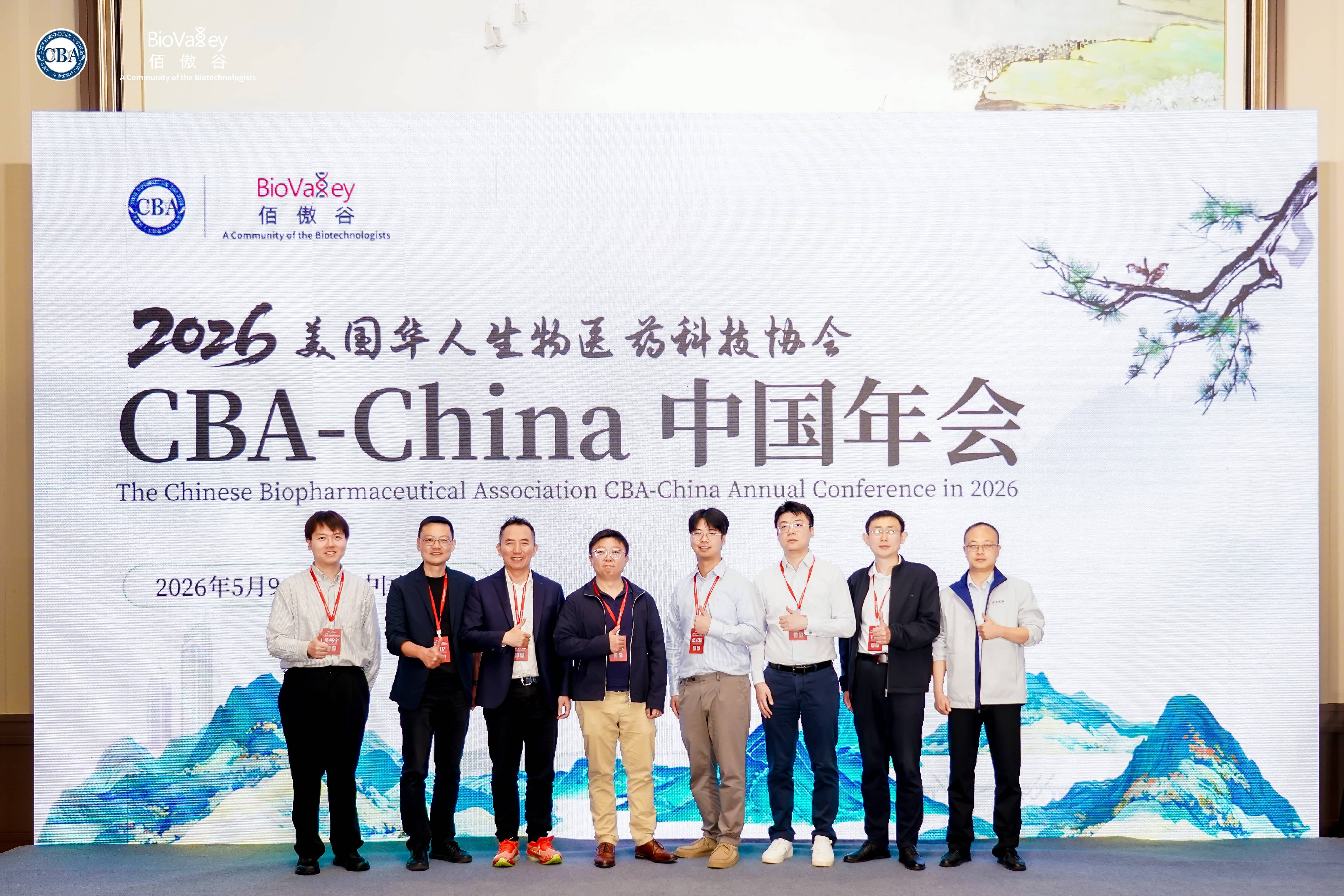
CBA-China 2026 Conference
In antibody R&D, the industry has been grappling with shared challenges:
1. How can we find effective candidate molecules faster?
2. How can we reduce experimental screening costs?
3. How can we improve R&D success rates?
4. How can we effectively retain and coordinate complex R&D processes?
The value of AI is shifting from "improving efficiency" toward "restructuring the R&D process." During the conference, Dr. Tianyuan Wang, CEO of Clickmab, gave a talk on "AI-Driven Structural Biology Innovation to Accelerate Novel Drug Target Discovery and Precision R&D," introducing the core capabilities and design philosophy of Click.mAb.—a precise, efficient, and easy-to-use AI agent platform for full-process antibody drug R&D.
From Epitope Design to Humanization: AI Goes Deep into Key Antibody R&D Stages
Click.mAb.—A Precise, Efficient, and Easy-to-Use AI Agent Platform for Full-Process Antibody Drug R&D
At this conference, Clickmab highlighted its practical capabilities across several core R&D scenarios.
1. Epitope-Specific De Novo Antibody Design
Generating candidate antibodies directly around specified epitopes enables rational design driven by functional requirements. This has long been regarded as a highly challenging problem in antibody design, but the combination of AI and structural biology is making targeted design increasingly feasible. These capabilities have been validated across multiple target projects, yielding candidates capable of hitting specific epitopes.
2. AI-Driven Affinity Maturation
Traditional affinity optimization often relies on extensive random screening, while AI can now identify complex spatial coordination relationships between residues. Compared to single-point mutation strategies, cooperative mutation optimization achieves more effective affinity improvement using smaller libraries. This not only means greater efficiency, but also signals a shift in R&D logic from "trial-and-error driven" to "structure- and data-driven".
3. Antibody and Nanobody Humanization
In humanization, Clickmab demonstrated the combined application of AI structure prediction and a large-scale human framework database. Unlike traditional empirical approaches, AI can search a broader sequence space for candidate solutions, improving humanization levels while maintaining activity, expression, and stability. For nanobodies (VHH), this structure-level holistic assessment is significantly reducing experimental screening costs.
The Next Stage of AI Platforms: From Personal Tools to Team Collaboration
Beyond core algorithmic capabilities, another frequently discussed topic is how AI truly integrates into R&D teams.
As AI-assisted design capabilities continue to strengthen, new questions are emerging:
1. How do we track the R&D process?
2. How do we manage multiple exploration paths?
3. How do we retain key findings?
4. How do teams collaborate based on unified information?
To address these questions, the Click.mAb. platform is continuously enhancing project-level collaboration capabilities, including: multi-path parallel exploration, automated R&D process archiving, automatic project knowledge accumulation, and team sharing with collaborative discussions—enabling AI to serve not just individual tasks, but the entire R&D workflow.
Discussing the Future of AI-Driven Pharma with the Industry
Clickmab Booth D72
During the conference, Clickmab engaged with visitors from pharmaceutical companies, biotech firms, research institutions, and industry partner organizations at Booth D72, exploring real-world application scenarios for the Click.mAb. platform.
If you are interested in the Click.mAb. platform and would like to understand its real capabilities in antibody design task decomposition, computational scheduling, structural analysis, and result integration, we welcome you to reach out for a discussion. Going forward, we will continue to center our work around real R&D scenarios, driving the deep integration of multi-agent AI technology with antibody drug discovery, and exploring more efficient and intelligent R&D models.
Shape the Future of Antibody Therapeutics Together
Clickmab is dedicated to empowering antibody discovery through generative AI and welcomes partners across the ecosystem.