We use cookies to enhance your browsing experience and analyze site traffic. By continuing to use this site, you agree to our cookie policy. Privacy Policy
Two Days at AsiaBIO: The 5 Questions We Answered Almost Every Day
On July 9–10, the AsiaBIO 2026 Innovation Summit (North China) was held in Beijing. Clickmab presented the Click.mAb. multi-agent AI antibody R&D platform, with CEO Dr. Tianyuan Wang delivering a keynote. Here we summarize the five questions we were asked most often on-site, along with our thoughts.
On July 9–10, the AsiaBIO 2026 Innovation Summit (North China) was held in Beijing.
As a major industry conference focused on frontier directions such as innovative antibodies, AI drug discovery, nucleic acid drugs, and peptide drugs, this year's summit brought together experts from pharmaceutical companies, biotechs, research institutes, and across the industry value chain to exchange the latest advances and practices of AI in new drug R&D.
At the summit, Clickmab presented the Click.mAb. Multi-Agent AI Antibody R&D Platform, and CEO Dr. Tianyuan Wang delivered a keynote titled "Click.mAb. — A Precise, Efficient, and Easy-to-Use End-to-End AI Agent Platform for Antibody Drug R&D."
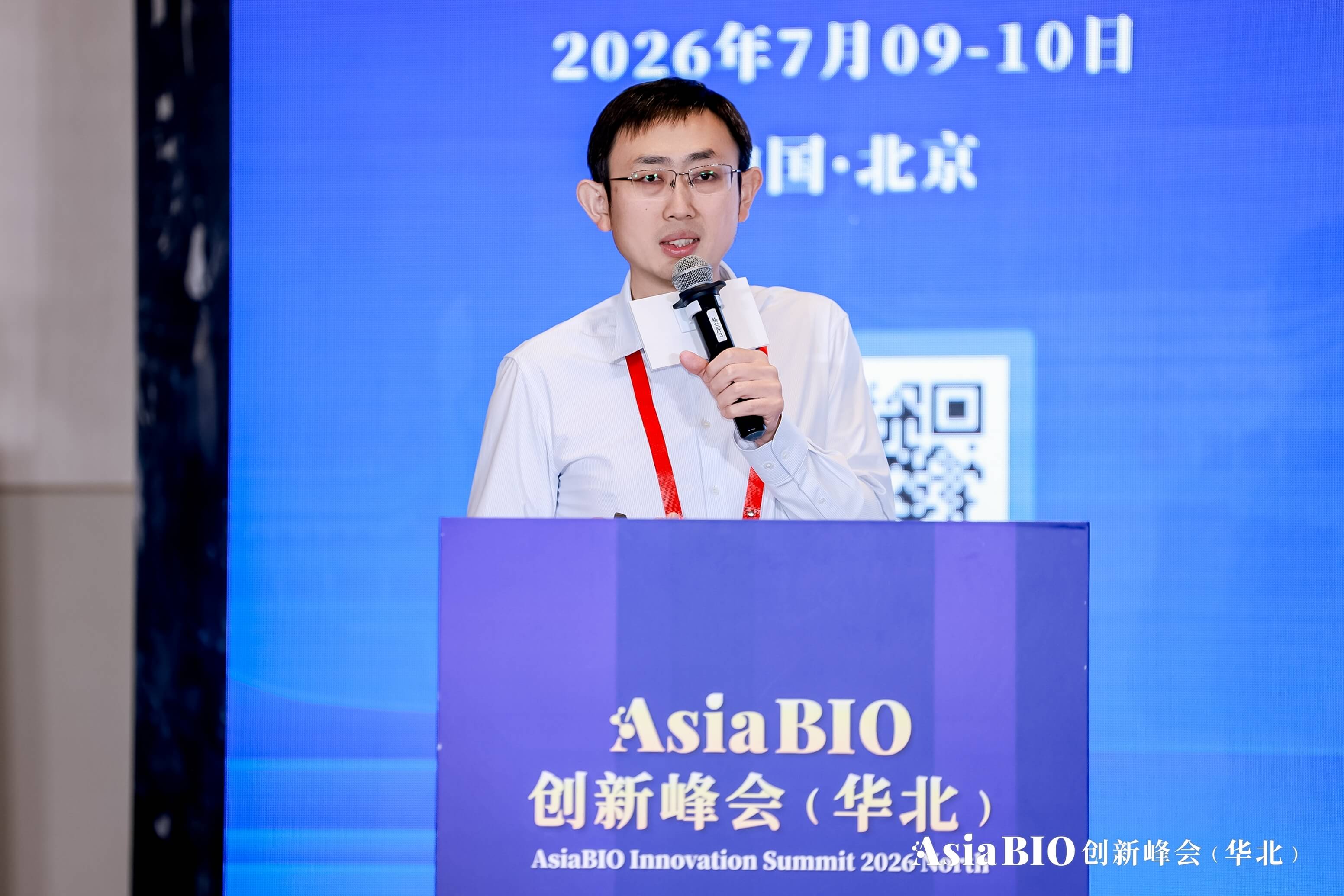
Dr. Tianyuan Wang delivering the keynote
Over the two days, we had in-depth conversations with R&D scientists from pharmaceutical companies, biotechs, universities, and research institutes. Although everyone focused on different directions, the conversations always came back to a few similar questions.
Here, we have summarized the five questions raised most frequently during on-site discussions, along with our thoughts.
Booth discussions
QUESTION 1 | Can AI Really Participate in Antibody R&D?
A few years ago, the discussion was mostly about: Can AI predict structures? Can AI generate antibodies? At this summit, however, we heard a different question far more often: Can AI truly participate in R&D? This is exactly the direction Click.mAb. has been exploring.
In our view, AI should not be just a chat tool, nor merely an algorithmic model that completes a single computational task. It should be able to understand research goals and help scientists advance their R&D work.
Once a scientist raises an R&D need, AI can carry out requirement understanding, task decomposition, workflow planning, tool invocation, and results analysis around that goal, and continue advancing subsequent tasks based on the analysis. Click.mAb. is therefore not a single algorithm, but an AI-Native antibody R&D platform built for enterprise research teams.
Through multi-agent collaboration, task planning, computational design, knowledge management, and project collaboration, the platform connects previously fragmented R&D stages, helping research teams complete the workflow from design and analysis to decision-making more efficiently.
QUESTION 2 | How Do AI-Designed Antibodies Actually Perform in Experimental Validation?
This was the question we were asked most on-site, and it is the ultimate test that every AI drug discovery platform must eventually answer.
Our answer is simple: let the hard experimental data speak.
8 real R&D projects validated · 7 projects yielded experimentally validated positive antibodies
To date, the Click.mAb. de novo antibody design workflow has been validated across 8 real R&D projects, 7 of which successfully produced experimentally validated positive antibodies. Candidate affinities span the μM to nM range, and after affinity maturation some candidates achieved more than a 10-fold improvement in affinity. Representative projects further confirmed, via Cryo-EM, that the antibodies bound precisely to the target functional epitope. These results show that the platform can not only generate candidate sequences, but also support downstream screening, optimization, and experimental validation around a specified epitope.
Cryo-EM validation of the bound epitope
QUESTION 3 | What R&D Work Can Click.mAb. Currently Support?
During our discussions, many scientists initially assumed our platform was mainly for de novo antibody design. In fact, the platform now covers multiple core stages of antibody R&D.
1 · Epitope-specific de novo antibody design
Generates entirely new candidate antibodies against a user-specified epitope, providing high-success-rate starting molecules for projects involving low immunogenicity, conserved epitopes, or hard-to-drug targets.
2 · Antibody affinity maturation
In a representative case, the best candidate achieved up to a 23.3-fold affinity improvement over the parent, with several candidates also expressing at higher levels than the parent — balancing binding performance and developability.
3 · mAb / nanobody humanization
In current representative cases, humanization reached up to 95% for both mAbs and nanobodies while still maintaining affinity and expression levels comparable to the parent.
4 · CDR diversity engineering (a major 2026 release)
In an upgrade project for a 2 nM active antibody against the Trop2 target, diversification was completed under the extreme condition of CDR sequence identity as low as 57%, ultimately producing:
2 candidates that retained affinity within 50% of the parent;
11 recombinant candidates with normal, high expression;
8 candidates whose SEC-HPLC purity (main peak) even surpassed the parent.
Compared with local optimization on the original sequence alone, CDR diversity engineering helps R&D teams explore a much larger sequence design space, opening up more possibilities for subsequent patent positioning and differentiated design.
QUESTION 4 | Is Click.mAb. Just a Toolkit?
Our answer is no.
This year we completed a major version upgrade of the Click.mAb. platform. The upgraded platform supports continuous R&D work, rather than being merely a collection of separate tools.
Take a new antibody R&D project as an example: the platform can carry out target research, sequence and structure analysis, epitope analysis, task planning, and computational tool invocation around the R&D goal, and generate summaries and recommendations based on the analysis at each stage. Scientists no longer need to switch frequently between platforms or repeatedly re-organize context, making the entire R&D process more coherent. The value of AI is not just completing a single computation, but helping the research team continuously advance their work.
Upgrades to the platform's core capabilities
QUESTION 5 | What Will Click.mAb. Focus On Next?
One clear impression AsiaBIO left on us this year is that more and more R&D teams are focusing on how AI can truly integrate into the R&D workflow, rather than on the models alone.
Going forward, Click.mAb. will continue to iterate around real R&D scenarios. On one hand, we will keep refining core algorithmic capabilities such as de novo antibody design, affinity maturation, humanization, and CDR diversity engineering. On the other hand, we will continue to strengthen platform capabilities such as multi-agent collaboration, project management, knowledge management, and team collaboration. Our hope is that when scientists open Click.mAb., they get not just an AI that can answer questions, but an intelligent R&D assistant that understands research goals and helps advance their projects.
Shape the Future of Antibody Therapeutics Together
Clickmab is dedicated to empowering antibody discovery through generative AI and welcomes partners across the ecosystem.